Is the Raspberry Pi an "Internet of Things" device? What does "IoT" device even mean?
Today I was asked to share some of my thoughts about the recent Raspberry Pi 2 + Windows 10 announcement and what it means in the world of “Internet of Things.”
Originally published on the Intel blog
- intel
- iot
Originally published at the Intel Software Evangelists blog on February 3, 2015. Recovered from the Internet Archive.
@rexstjohn Thoughts on Pi2 as a new enabler to your micro-computing movement? Looks like they’re targeting Windows devs too.
, Chuck Freedman (@chuckstar) February 3, 2015
Today I was asked to share some of my thoughts about the recent Raspberry Pi 2 + Windows 10 announcement and what it means in the world of “Internet of Things.”
One of the key things that I wanted to pick up on is that this particular arrangement is being supported by Microsoft’s Windows Developers Program for IoT, the implication being that the Raspberry Pi is categorized as an “Internet of Things” device.
But wait a second, isn’t the Raspberry Pi a tiny learning computer you can plug a mouse and keyboard into it? Are we now calling any tiny computer an IoT device?
I think with extremely broad, all encompassing terms like “IoT,” it is important to step back and ask ourselves: “Well, what does that actually even mean?”
Raspberry Pi basics
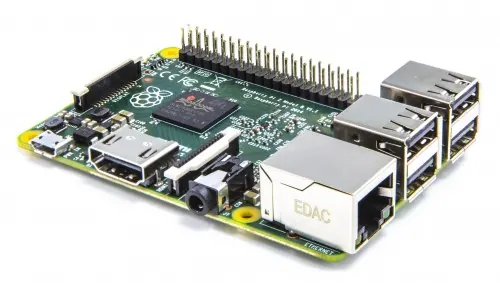
If you aren’t familiar, Raspberry Pi is a tiny computer with video and media capabilities that *“enables people of all ages to explore computing, and to learn how to program.”Once you take your Raspberry Pi out of it’s box, you can plug in a keyboard, monitor and mouse and be treated to a familiar “desktop experience.” One startup, Kano, has taken this experience a step further to make learning *even easier.
Understanding that, the question remains: “How did we get from calling Raspberry Pi ‘a teaching tool’ to calling it an ‘IoT device?’”
The answer comes in the form of Raspberry Pi’s compute module, which is a stand-alone component meant for end-users who plan on fabricating their own PCB boards (e.g. scaling Raspberry Pi technology for commercial purposes). This form factor enables startups to take the “guts” (e.g. the power and capabilities of a Raspberry Pi) and build and sell solutions.
If I am an HVAC analytics startup, I could take the Raspberry Pi compute module and build a system around it, including the inputs and outputs I see fit and ignoring the capabilities I don’t want (do I really need an HDMI port?). Next, I would “scale” by selling thousands or millions of these devices. At that point, my “learning computer” starts looking more like an “IoT device.” But is that enough to qualify?
Defining what “IoT Device” means
Lets extend this thought even further to talk about when and how we should use the term “Internet of Things” in relation to a hardware device like Raspberry Pi or MinnowBoard Max. What makes any given device an “IoT device” in the first place?
Here is what I think:
- Should support one or more “IoT protocols” and not be bound by wired ethernet (examples: BLE, Wi-Fi Direct, ZigBee, Z-Wave, EnOcean, ANT+, 6LoWPAN etc)
- Very likely a transportable SoC module which startups can build products with
- Often sold with various hobby breakout boards and kits
- Small enough to wear or install in a thermostat (or smaller)
- Very low power consumption, can run for long periods on battery
- Most of the software will be deployed and managed over the air, not a wire
- Will be (often) managed via the cloud or other device like a mobile phone
- Will have little or no direct user interface of it’s own (no monitor, keyboard or mouse)
The current Raspberry Pi and compute module (unlike devices such as Spark Core, Intel Edison or LightBlue Bean) don’t come default with Bluetooth (Smart / LE or Classic) or Wi-Fi without adding additional components or USB dongles, Ethernet only. Furthermore, providing as many additional media input / outputs as the base Raspberry Pi has (which is specifically built for learning) make it unwieldily as an IoT device.
Do we really need video or media capabilities from a device which is probably mostly going to be sending all of it’s data to the cloud or exposing it’s interface to a paired mobile device? Are we going to be programming our IoT devices with a mouse and keyboard or will we be deploying software to these devices over-the-air en masse using a system like resin.io involving GitHub and Docker containers? I am a fan of the Docker approach myself and I don’t think the IoT will be “about” putting images on monitors with progressively smaller computers (though a GPU might come in handy for certain classes of calculation).
What we are left with looks to me like a small (yet capable) computer and not an “Internet of Things”-specific device. That isn’t to say that couldn’t change or that sub-flavors can’t be built to add these features.
I am open to hear what people’s thoughts are on this matter (Is wireless connectivity really a requirement? Are there many IoT applications which must have video and media capabilities? Is any small computer with an ethernet jack an IoT device?). I welcome your thoughts and opinions!