Is “Stone Soup” The Greatest Business Book Ever Written?
I recently picked up a copy of Marcia Browns’ 1947 “Stone Soup.” As an elementary school student, I didn’t really appreciate Stone Soup.
Originally published on the rexstjohn.com blog
- devrel
Originally published at rexstjohn.com on September 9, 2017. Recovered from the Internet Archive.
I recently picked up a copy of Marcia Browns’ 1947 “Stone Soup.” As an elementary school student, I didn’t really appreciate Stone Soup. As an adult, I have to say that that Stone Soup is a shockingly accurate reproduction of the process truly great entrepreneurs and salespeople use to win.
In fact, I would go so far as to say that Stone Soup may be the greatest sales manual and business book ever written!
So lets get into it.
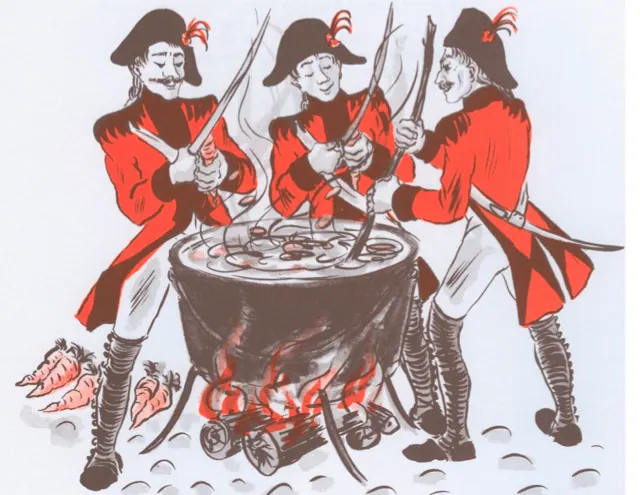
The story opens with three French-looking soldiers who have not eaten in several days, they are starving to death. For the sake of this article, lets think of these soldiers as entrepreneurs, sales people, technical evangelists or business development people.
Seeing the soldiers coming from a long way off, the local villagers immediately recoil in terror. From past experience, “Soldiers” (ahem salespeople / recruiters) coming to town always means bad news.
Having had their opinions about oncoming Soldiers (ahem salespeople / recruiters) tainted from past experience, the villagers have no interest in making life easy for the starving wanderers.
So the peasants do exactly what your potential customers and investors are going to do if you telegraph that you are going to try to ask for money / sales. The villagers immediately go and hide every single morsel they have (and they have abundant morsels to hide).
When the soldiers get into town, they are met by groaning peasants pretending to be starving, grasping their stomaches acting as though they have not eaten in months.
This behavior should be familiar to you if you have ever…
- Managed employees and asked them to do any work
- Tried to sell anything, to anyone, ever
- Attempted to convince your children or significant other to perform chores
- Asked investors for venture capital
- Tried to organize an event which requires people to buy a ticket
Oh so many reasons! You will hear so many reasons from your investors and customers, believe me.
So the soldiers, especially the smug looking guy in the center, come up with a crafty plan.
Knowing they have nothing to offer, can’t use force, asking nicely is exhausted and are walking into the situation facing significant resistance which they can’t overcome (as every salesperson, recruiter and entrepreneur does, every day of their lives)…the soldiers decide to refactor their request.
This moment is the key to the entire story: The soldiers decide to restructure their “selfish need” as a “collective good,” enlist their customers as partners, remove themselves from the sale and turn the direct sale into an indirect sale. What is about to follow is a sequence of events which cement the fact that this is the greatest manual on sales and business development ever committed to paper.
So the soldiers come back from their huddle. They immediately acknowledge that the peasants of the village don’t have any food: *“We realize that you don’t have any food, so instead we are just going to have to make some stone soup!”*This is classic sales best practice: Never refute, never argue…Acknowledge the customer’s complaint and agree with them….but keep advancing the sale!
Instead of getting stuck arguing about “price / availability of food” with the farmers (and accusing them of being liars for pretending not to have any food), the soldiers ask for something else: An iron pot to make stone soup with. They keep the sale moving!
At this point in the book, I came to the conclusion that whoever wrote it must be one of the greatest sales geniuses of all time. There is simply no alternative explanation. If you have ever studied sales and marketing, you will instantly recognize which this request is:
- Reasonable
- Free for the customer
- Engages the help of the customer
- Is likely to be a “yes”
- Interesting to the customer
- Keeps advancing the sale
- Provides value (if you bring the pot, we will do a magic trick for you!)
And with this request, the soldiers begin a “Campaign of Yes” with their customers…
After the farmers provide an empty Iron Pot, the soldiers proceed to ask the villagers for water to put in the pot, logs to burn and three stones (for soup!). All of these requests are “Free and Easy” to provide. With each request, the villagers become more and more involved in the process of creating the stone soup.
The ultimate persuasion pattern emerges: Yes to getting a pot, Yes to getting fire and kindling, Yes to getting water, Yes to getting three stones. After fulfilling these small requests, the farmers have been transformed from being passive actors into active participants in the sale…the farmers are beginning to OWN the result of the sale by partnering with the soldiers to deliver it.
And now the kill shot.
If you have ever expect to sell or attempted to persuade anyone to do anything…you should hang a print-out of this image on your wall and look at it every single day. This sentence and phrasing is so good I could write a book about it. .
“Any soup needs salt and pepper…” said the soldier, masterfully. I will try my best to explain why this phrasing is so incredibly good:
- It’s an Indirect Order relying on the power of suggestion…
- The phrasing of this “Indirect Order” as an observation triggers immediate action by whoever hears it, the farmers have been transitioned into a “Helpful” state at this point and are open to suggestion now…they comply!
- This is also a Trial Close…
- A Trial Close is a sales technique where the salesperson asks a special question to assess the readiness of the customer to make the purchase without asking for the sale overtly.
- Trial Closes are a classic method for taking the temperature of their customer to making a true sales request.
By complying with this request for Salt and Pepper, the farmers show the soldiers that they are now in a mood to comply with a “real” request…
BAMN! This is “The Mythical Close” itself. Seeing the farmers willing to comply for a request very close to food, they next observe that carrots would be an even better addition to the soup…
Once again, the soldiers phrase the request indirectly. The farmers, now enlisted as partners in the sale immediately comply and go and fetch the carrots, not realizing that they have broken their cover (we have no food) of “Reasons.” Soon, the farmers are agreeing to subsequent requests for more food and rushing back and forth to their larders fetching beef, barley, oats, salt and pepper, cabbage…
Notice that the soldier is not asking for carrots to feed himself, he is observing that carrots would make the soup better. By removing himself from the sale, the soldier puts the focus on improving the solution (The Stone Soup) and not lining his own pockets (something that produces resistance in customers).
Before you know it, the stone soup event has broken into a full on music festival / banquet. What started as a magic trick has become a sales bonanza for all. Everyone partakes in the event and eats to their fill, All because of a story about making soup out of stones. Everyone wins.
By restructuring their desire for food into a collective good, enlisting the help of the customers and removing themselves from the sale, the soldiers managed to achieve a result by offering nothing but an interesting story and a well-crafted series of statements into a feast.
Closing Thoughts
- What is something that you personally want for yourself?
- Is there a product you wish existed?
- Is there an event you wish occurred?
- Is there a service you want to sell?
- Are there people you want to do something for you?
- How can you restructure this “Selfish Desire” into a “Collective Good” to enlist others to help you achieve it?
- If you want to be a rock star, perhaps consider organizing a music festival or open-mic to draw in other musicians to help you…
- If you want investment, consider asking for their advice…
- If you are a recruiter, organize an event and ask your target for their help in producing useful content to showcase how smart they are…
- If you want to sell customers a product, such as a video game, start a forum and ask them to help you design it (this is how MineCraft turned into a billion dollar game)…
- Focus on enlisting your customer to help you deliver the solution, not selling!
My final closing thought is on Elon Musk, the greatest practitioner of the sales arts on earth. What does Elon Musk do? Why are his businesses so successful? Its because everything he does is positioned to help all of humanity.
Tesla cars to save the environment, SpaceX to save humanity by offering travel to Mars…by focusing on selling the collective good, Elon Musk has amassed an infinite loyal customer fan base and enlists his customers to help him achieve a greater good: Saving humanity (while also becoming immensely rich himself).
Adios.