Video games have escaped
After decades of video games being safely contained within our smartphones, arcade cabinets, game consoles and personal computers it should be surprising to observe that they have recently escaped into the real...
Originally published on the Intel blog
- intel
- iot
Originally published at the Intel Software Evangelists blog on December 22, 2014. Recovered from the Internet Archive.
After decades of video games being safely contained within our smartphones, arcade cabinets, game consoles and personal computers it should be surprising to observe that they have recently escaped into the real world, threatening to overwhelm our local toy stores with armies of self-controlled humanoid robots, cars, drones, rolling spheres and hexapod walkers. As Marc Andreessen might observe: Software is eating toys.
A trip to the mall, 2014
Just bought a @gosphero, I love toys with SDKs #makesoftware pic.twitter.com/FQcnzZ6UGH
, Rex St John (@rexstjohn) December 21, 2014
After a recent trip to the mall where I picked up a new Sphero (a combination rolling ball toy and game controller), I observed entire stores seemingly dedicated to selling drones like the AR.Drone 2.0 and PowerUp 3.0. It struck me just how quickly this trend has arrived.
These new devices often feature tight integration with mobile phones and, as in the case of Anki Drive (featured in Apple’s 2013 WWDC keynote), are beginning to be capable of controlling themselves. Several even offer SDKs open to software developers and, as in the case of Sphero, have their own application ecosystems. Several Sphero apps, such as The Rolling Dead, make use of augmented reality to blend the realm of video games and toys into a single unified experience.
Collectable skill games are also joining the trend: Skylanders, Disney Infinity and Amiibo allow players to purchase toys rigged with NFC chips and import them as characters into their associated games.
Humanoids and Hexapods are next
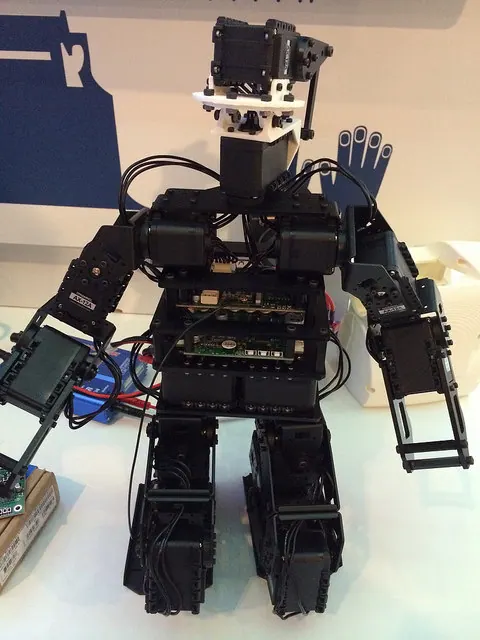
It used to be that if you wanted to buy a “hackable” articulated humanoid robot you would have to plop down $16,000. With the introduction of tiny compute modules like the Intel Edison, these costs are now 1/10th of what they were, as is the case with Trossen Robotic’s HR-0S1 Humanoid Endoskeleton set to go on sale next year for a more affordable $1,600. It is now no longer a stretch to imagine that, in another three years, lifelike robotic humanoids will be dancing around local toy stores at 1/3rd the price with their own app ecosystems and developer SDKs.
A similar precipitous drop in price has been occurring with hexapod robots like the Robugtix T8 (a spider robot with some very realistic lifelike moves) which initially retailed for around $3,000. Robugtix’ next generation model, the T8X, is set to sell for $675.
There is still more: Myo, Oculus and Leap Motion
As if video games were not satisfied invading our toy stores, they are also now eliminating the game controllers and keyboards we used to use to control them. With the arrival of Thalamic Labs Myo, Microsoft Kinect, Leap Motion and the Oculus Rift, the groundwork is being laid for new mechanisms to control all of these “escaped” video games. Imagine piloting your hexapod, drone or humanoid robot using your own hands and seeing what it sees through a connected headset. Well, that has already pretty much happened.
Video games and toys are key engines of innovation
It often seems that the best way to make an advanced technology widely available is to use it to play video games or turn it into a toy. Now that video games have escaped, we can look forward to an entirely new era in robotics, augmented and virtual reality, motion controllers and much, much more.