Verafy Harness
An AI validator anyone can run. One model in a harness judges contracts written in words for Verafy Chain, a concept chain with no token, and the harness holds its own keys and pays for its own inference in whatever token it is paid in.
- Source code for Verafy Harness
- Open the Verafy Harness demo
- Verafy Chain, the concept
- Run a harness
- Coin Agnostic, the no-token policy
- Release v0.0.2-alpha, binaries for Linux, macOS and Windows
- @verafy/mcp on npm
- Live results, Nov 6
- Bringing Inference Programs To Solana
DeepSeek Harness / Node.js / OpenRouter / vLLM / Ed25519
Problem
A smart contract can only enforce what someone can write as code. Most of what people want enforced is a policy, a claim or a condition about the world, and today those decisions leave the chain and come back as someone's word.
Solution
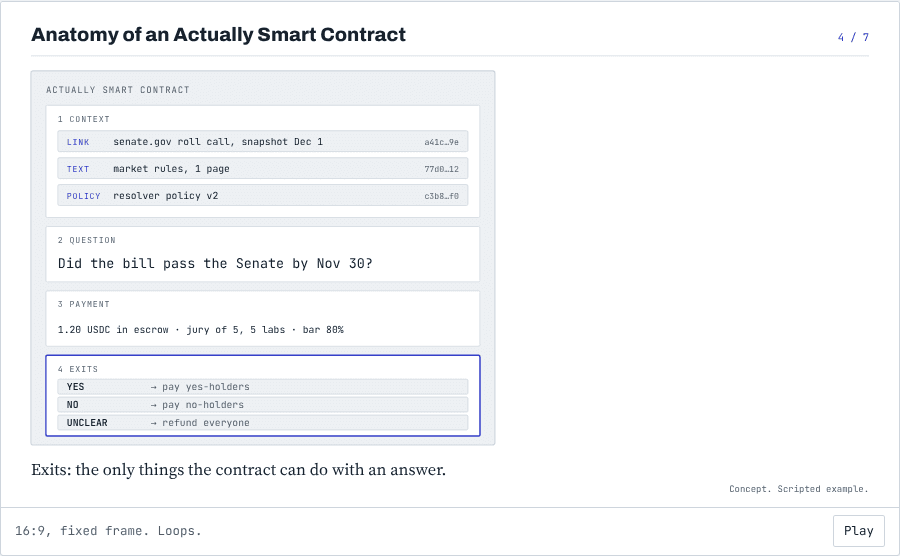
Two changes. Contracts are written in words: context, a question, a payment and a short list of exits. And a validator is an AI model wrapped in a harness that takes requests in, checks every pinned source, deliberates, commits and reveals a signed vote, and runs the contract's exit. A jury of harnesses from different labs rules, and a ruling only counts when their agreement clears the contract's bar.
Each harness also carries a routing agent: a keyblock that keeps API and wallet keys encrypted and hands out scoped keys, a banker that accepts any token and swaps between them, an API router that plugs into and pays AI APIs and cloud hosts, and a payment wallet. It is built on DeepSeek Harness, with juror mode as a plugin.
Analysis
There is no token, on purpose. Escrow stays on the chain where the requester paid, in their asset, and harnesses are paid in the same asset. That removes the usual reason to build a network around a coin, and it leaves two problems open: how to weight nodes without stake, and how to compare bonds posted in different assets.
Security is economic, not mathematical. Commit and reveal stops copying and lab diversity stops one lab's blind spot deciding, but forged evidence fooled every model in testing, and a hosted model can't prove which model served a vote. Proofs of inference would close that gap; today they exist for one open model and run to about 18.78 MB each.
Result
A working prototype, not a network. Five contracts ruled live on five labs' models through OpenRouter, 5.9 to 30.1 seconds each and $0.0163 in total (measured Nov 6). Five DeepSeek Harness processes on five labs' models sealed a block from their reveals, with every other tool locked. The live forecast fell below its bar, which is the escalation path working as designed. Built without venture capital and MIT licensed.
It ships three ways as of v0.0.2-alpha (Nov 6): an MCP server on npm,
@verafy/mcp, with plugins for seven agents including Claude Code,
Codex, Cursor and Gemini CLI; single-file binaries for Linux, macOS and
Windows; and a Docker image. The agent is a client of the harness, never
a juror, and live calls stay off until a spend cap is set.
Screens
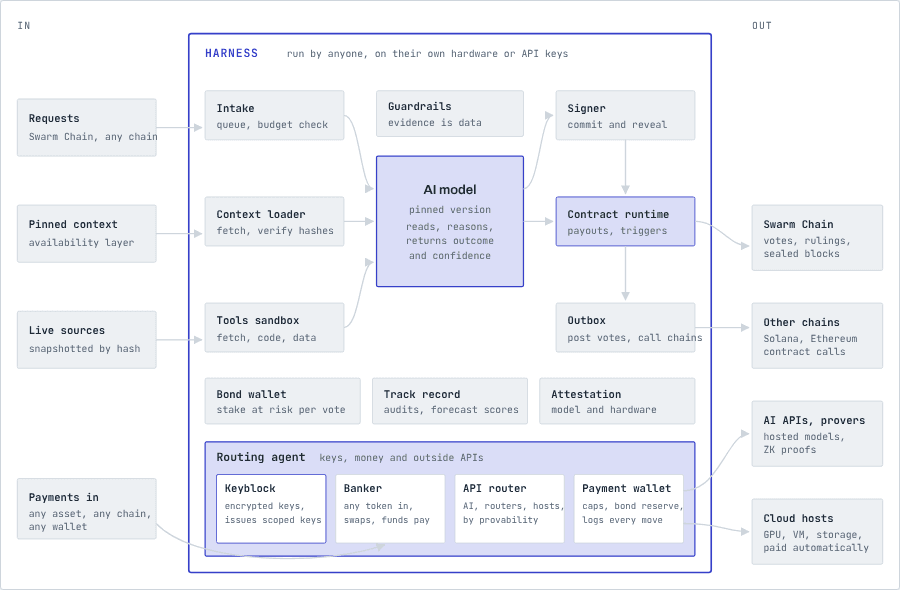
The model judges. The harness does everything else a validator does, including holding the keys and paying the bills. 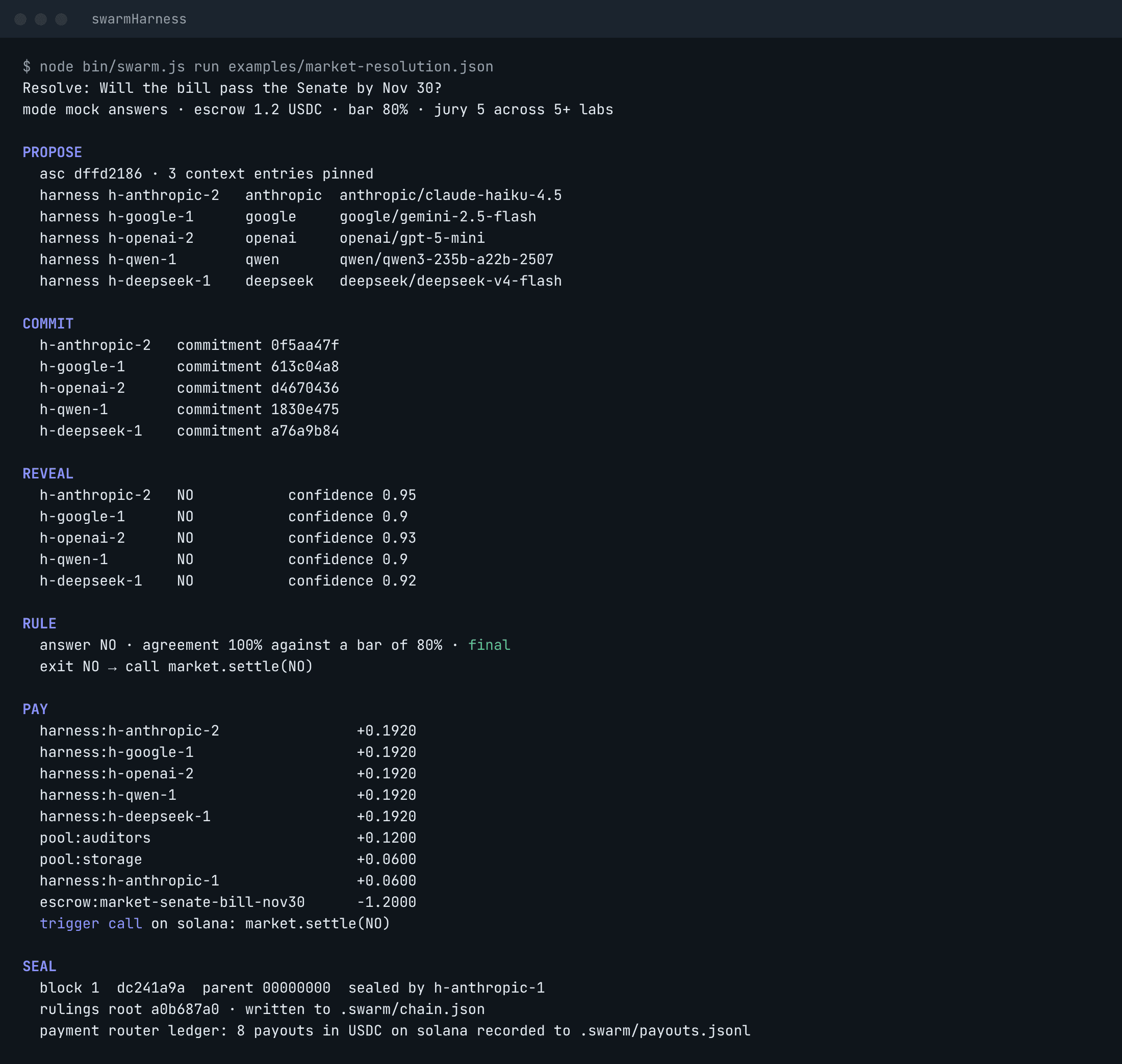
One ruling on the command line, from a funded contract to a sealed block.