EVMLLM and SVMLLM Run Smart Contracts on Transformer Weights
Two Verafy research demos. SVMLLM puts a small Solana VM inside hand-set transformer weights. EVMLLM runs a small Ethereum VM on a computer compiled into transformer layers. Both match their reference VMs on every test so far.
I built two small research demos at Verafy that run smart contract programs inside the machinery of an AI model. SVMLLM does it for Solana and EVMLLM does it for Ethereum. Both are open source: Verafyai/svmLLM and Verafyai/evmLLM.
Where it started
This started with Qwenputer by divagr1925. Qwenputer is a small computer built out of transformer layers, the same building blocks an AI model is made of. Every weight is set by a compiler, and nothing is trained. When I read it, my first thought was: if a transformer can be a computer, it can run a blockchain VM.
Why bother
Smart contracts are exact and trustless. They do exactly what the code says, even when a sensible person would stop it. AI models are the opposite: good at context and judgement, not exact on their own.
The long term goal is one model that does both. The contract runs exactly, and then a check asks whether the result makes sense. Today that check is a set of simple rules that sit outside the model. It looks at the amount, the destination and the usual pattern, then says allow, hold or block with a reason. It is there for illustration only. It is not a security product.
SVMLLM, a Solana VM in the weights
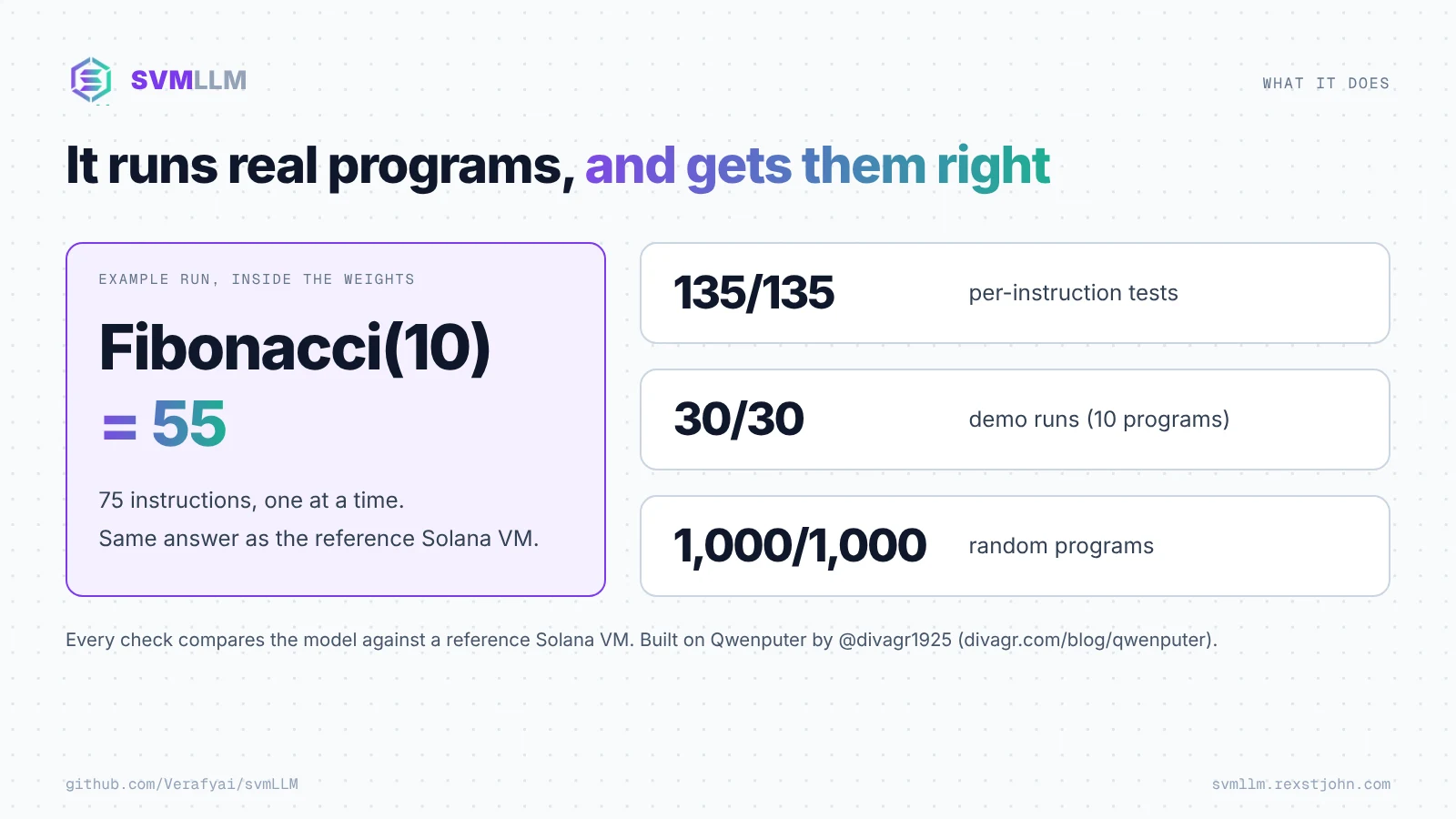
SVMLLM runs a reduced version of the Solana VM. The machine is about 1.1 million parameters that I set by hand, none of them trained. It does 64 bit math, one instruction at a time, and every result is checked against a reference Solana VM.
- 135 of 135 per instruction tests match.
- 30 of 30 demo runs match.
- 1,000 of 1,000 random programs match.
EVMLLM, an Ethereum VM on a computer made of weights
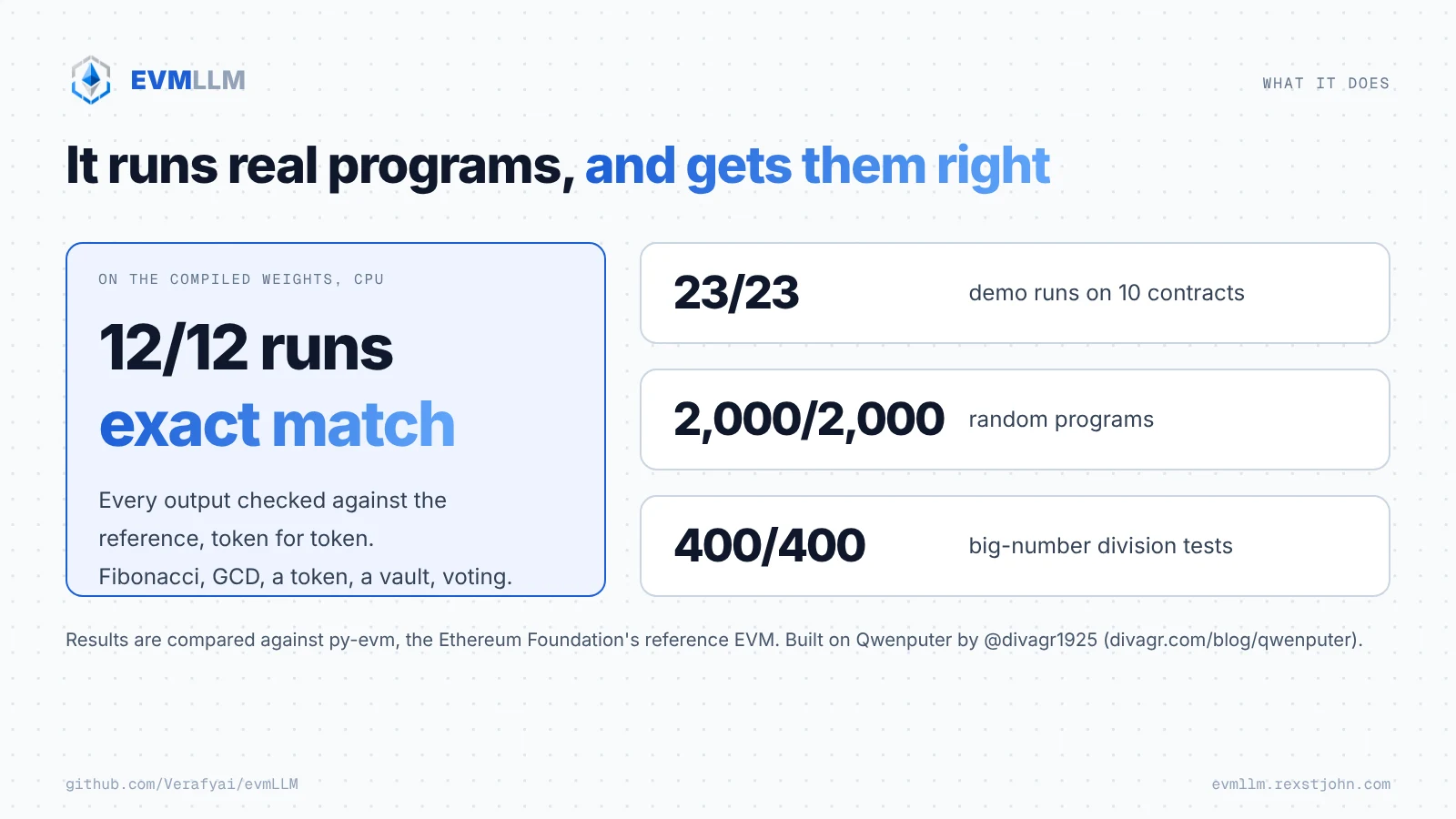
EVMLLM takes a different route. I wrote a small Ethereum VM as an ordinary program and ran it on Qwenputer's computer, which is compiled into transformer layers. So the weights run the computer, and the computer runs the EVM. Results are checked against py-evm, the reference Ethereum VM.
- 23 of 23 demo runs match.
- 2,000 of 2,000 random programs match.
- 400 of 400 big number division tests match.
- 12 of 12 runs on the compiled weights, on a CPU, match the reference token for token.
The honest part
- Both are slow. SVMLLM takes a few milliseconds per instruction on one CPU thread. EVMLLM runs at under 200 tokens a second on a CPU.
- Both are reduced VMs. SVMLLM has no accounts, system calls or calls to other programs. EVMLLM has no hashing, calls, new contracts or logs.
- Both are research demos, not a validator or a node.
- Merging either one into a full AI model is future work and untested.
Try them
- SVMLLM: svmllm.rexstjohn.com and github.com/Verafyai/svmLLM
- EVMLLM: evmllm.rexstjohn.com and github.com/Verafyai/evmLLM
Drop me some Solana if you want to support me to keep working on this: 86pEFG22pV4hd9wH48TSnATLo8U9bAraM8C58NAmPtuy
Drop me some ETH if you want to support me to keep working on this: 0xF2c09bB10Fd950095DD14Ff3289B82f9E264d826