The Rise of the Forward Deployed Engineer
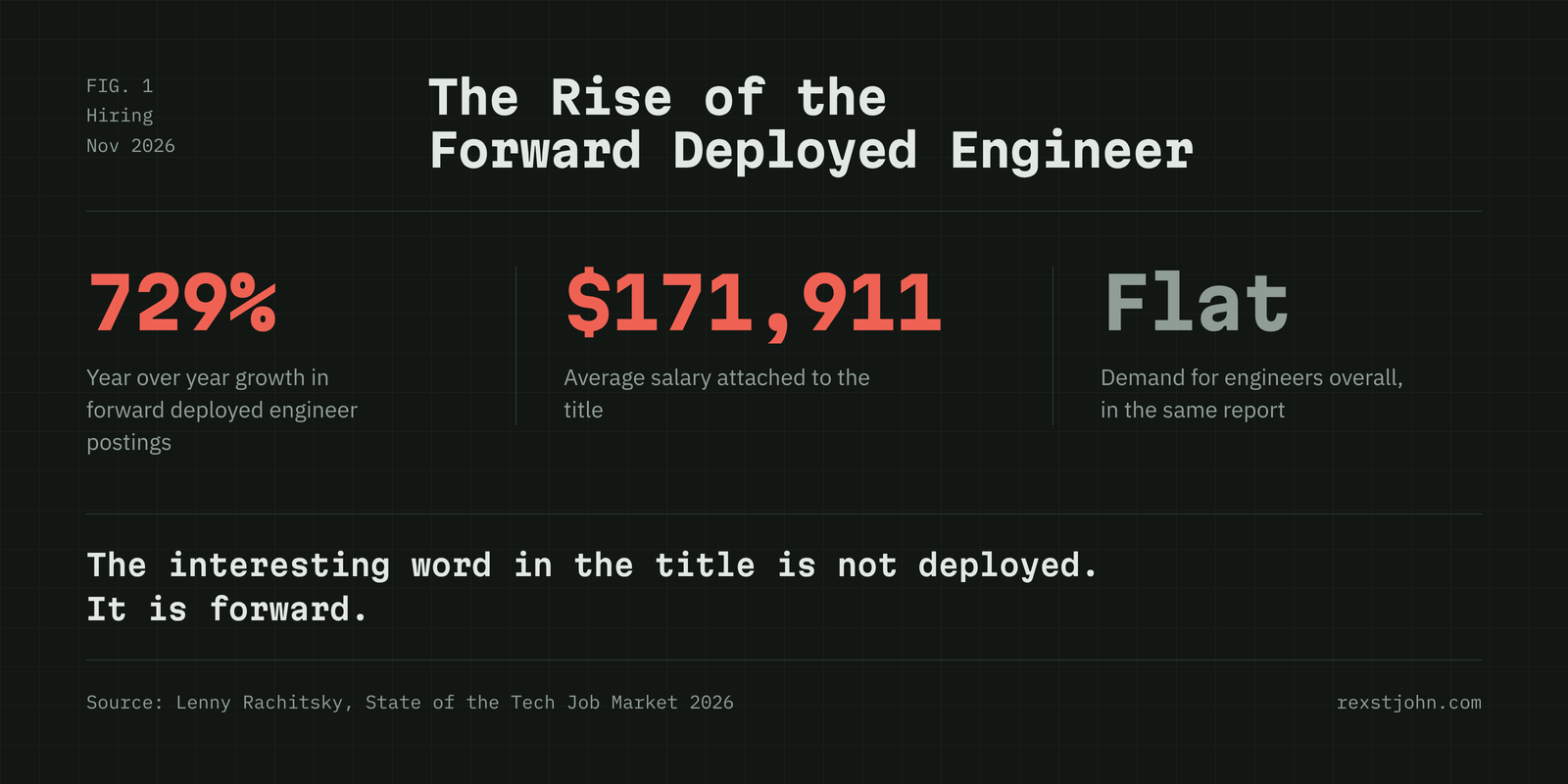
Forward deployed engineer postings are up 729% year over year. The interesting word in the title is not deployed. It is forward: the work arrives before the customer asks for it.
Forward deployed engineer postings are up 729% year over year, and the average salary attached to the title is $171,911. Those numbers are from Lenny Rachitsky's State of the Tech Job Market report, published November 10, and I saw them first in Prasenjit Sarkar's read on them. In the same report, demand for engineers overall is flat. One role going up 729% while its own category stalls is not a hiring trend. It is a category being replaced by something.
Silicon Valley invents a job title roughly every other week, so the reasonable first reaction is to wait it out. Growth engineer. Sales engineer. Developer relations engineer. Full stack engineer. Front end engineer. But look at that list again: each one was a real answer to a real change. Front end engineer appeared when browsers got good enough to carry an application. Growth engineer appeared when distribution became a measurable system instead of a budget. Sales engineer appeared when the product got complicated enough that the buyer could not evaluate it alone. The titles are faddish. The pressures underneath them are not.
So the question is not whether forward deployed engineer sticks. It is what changed.
The word is forward
The industry is reading this title as "deployed," and hearing a familiar story: embed an engineer in the account, sit next to the customer, make the thing work in their environment. Palantir ran that playbook for years, and the usual framing is that everyone else finally caught up to it.
That is the smaller half of what is happening. The word carrying the weight is forward.
Customers and developers have less time and less willingness than ever to investigate a product, learn its model, and build the thing they actually needed out of its parts. That patience has been draining for a while. What finally broke it is that the cost of building collapsed. When a working implementation is an afternoon of work instead of a quarter, "here are the primitives, go build" stops reading as empowerment. It reads as homework.
Forward means the work shows up before the ask. You talk to a customer, you watch how they operate, and before they have specified anything, something lands that does eighty percent of the job. Not a diagram. Not a reference architecture. A thing they can run.
I have been calling this real-time product, and I think it is the actual shift underneath the hiring number.
Five functions collapsing into one
Here is the part that makes this a category change rather than a new title.
Marketing figures out who the customer is and what they care about. Sales finds out what is in the way. Engineering builds. Developer relations teaches. Content explains. Each of those is a separate team, with separate headcount, separate tooling, and a handoff between every pair of them.
Building is now cheap enough that the handoffs cost more than the work. One person who listens like a consultant and builds like an engineer can go from hearing a problem to shipping something against it inside a day. The moment that is true, splitting the job five ways stops being specialization and starts being overhead.
That is what a forward deployed engineer is, in the version of the role I find convincing: not a field engineer attached to a sales team, but the point where marketing strategy, product thinking, and engineering stop being separate jobs.
Templates are the unit of work
If the output is "something that runs," the practical question is what you build before you know who is asking.
The answer is templates. Not documentation, not samples, not a starter repo nobody maintains. Pre-rolled, customizable set pieces, closer to what Canva gives a designer than what a quickstart gives a developer. Someone forks one and is most of the way to their own solution in an afternoon.
Getting that right is a research exercise before it is an engineering one, and it is a good use of an AI harness:
- Segment. Ask what kinds of customers actually exist in this business, not what the marketing site says they are.
- Map the use cases each segment is really trying to complete.
- Locate the friction. The specific step where people stall, abandon, or file a support ticket.
- Build against the friction, one forkable template at a time.
That loop is marketing research and product engineering running as a single motion, which is exactly the collapse described above, made concrete.
The outreach becomes the artifact
Follow this to where it goes and the cold email stops being an email.
The old opener was a message asking for a meeting. The new one is: I saw what you said you were struggling with. I built it. It is on my GitHub. Want it?
The engineering is the sales motion. The marketer of this era shows up with a working solution attached, because producing one costs a day rather than a quarter. The pitch and the deliverable are the same object.
The part I could be wrong about
Worth saying plainly: most of the postings behind that 729% are not describing this. They are describing implementation consulting with a better title, where the engineer embeds, integrates, and leaves before anyone measures whether the customer's outcome changed. FDE Directory made exactly this point in reply to Prasenjit: the growth is real, and most of the new postings still stop at the embed.
That is a fair reading, and it may hold for a while. A title can be hired against the old job for years before the market figures out what it was really pointing at. But the pressure underneath it does not go away, because the thing that created it, building getting cheap, does not reverse.
Why this favors generalists
This is also the honest reason I find the role interesting rather than just well paid.
The work rewards someone who can sit in a customer conversation, see the business shape of the problem, build the thing, and explain it afterward. I have done those pieces in different orders: developer ecosystems at Intel, Arm and NVIDIA, edge AI and robotics platforms, agentic systems at Verafy, and before that shipping iOS and Android products for Verizon, ESPN and Volkswagen. For most of that, being a generalist was something to apologize for in interviews. Specialists got promoted, and the person who could do all five functions was told to pick one.
This is the first title I have seen that is specified as all five on purpose.
Product is becoming content: real-time, on demand, and increasingly ahead of demand. Push product. The engineers who do well in that world will be the ones who were never good at staying in one lane.