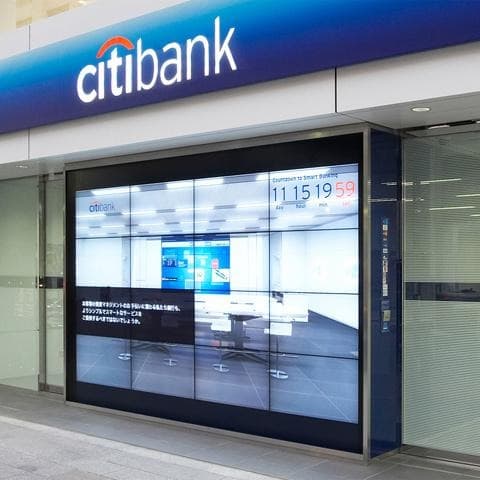
Citibank TouchWall
The second version of Citibank's in-branch media wall, rebuilt from a hundred pages of Eight Inc specification in a thirty day window and deployed to Tokyo, New York and Singapore.
Numbers
- 100 pages
- Spec implementedinteractive design from Eight Inc
- 3
- Cities deployedTokyo, New York, Singapore
- 16 ft
- Screen size supportedsquare, across multiple resolutions
- 5
- Team size
- 3.5 months
- Build time
Problem
Citibank had rolled out a first-generation media wall to branches around the world, part of Eight Inc's plan to do for retail banking roughly what the Apple Store had done for consumer electronics. It had aged badly and needed a rebuild rather than a patch — on a new form factor, across screen resolutions up to sixteen feet square.
Solution
Lead Flex developer on the second version. I took a hundred-page interactive design from Eight Inc's designer, distilled it into a task list against the existing wall, and implemented it — working to a thirty day window with nightly builds going out for client review.
Analysis
Wall-sized touch surfaces break the interface assumptions you bring from desktop and phone. Reach, dwell and who else can see your screen all become design constraints — in a bank, the last one most of all.
The part that decided the outcome was triage. A hundred pages against a thirty day window means some of that specification cannot ship, and the job is cutting the impossible features down to deliverable ones early and saying so, rather than discovering it in the final week.
Result
Released 28 March 2011 and deployed to branches in Tokyo, New York and Singapore, with dozens of new features over the version it replaced.
Photos
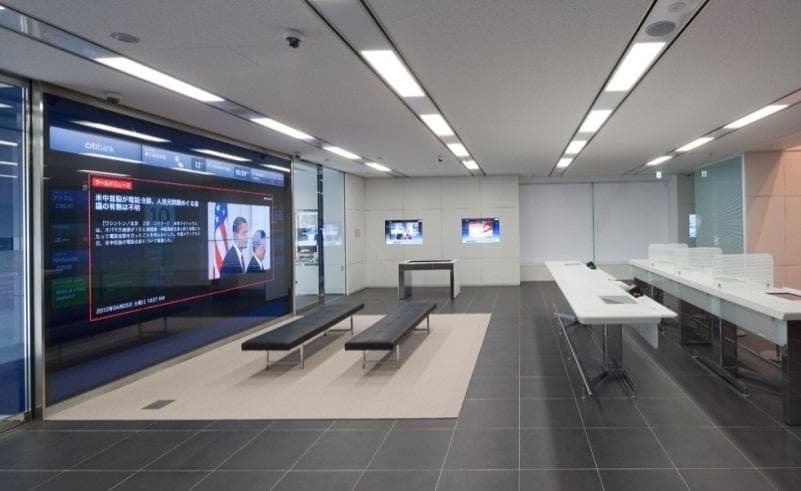
In the branch. The screen is the size of the wall, which changes every assumption about the interface on it.