ShedLife, SimCity for Building a Real Property
I built ShedLife at the Claude for Games hackathon. It's a near-sim on a real King County parcel where every permit, fee and rule is real, every move is an email to a real agency, and Claude voices every reply.
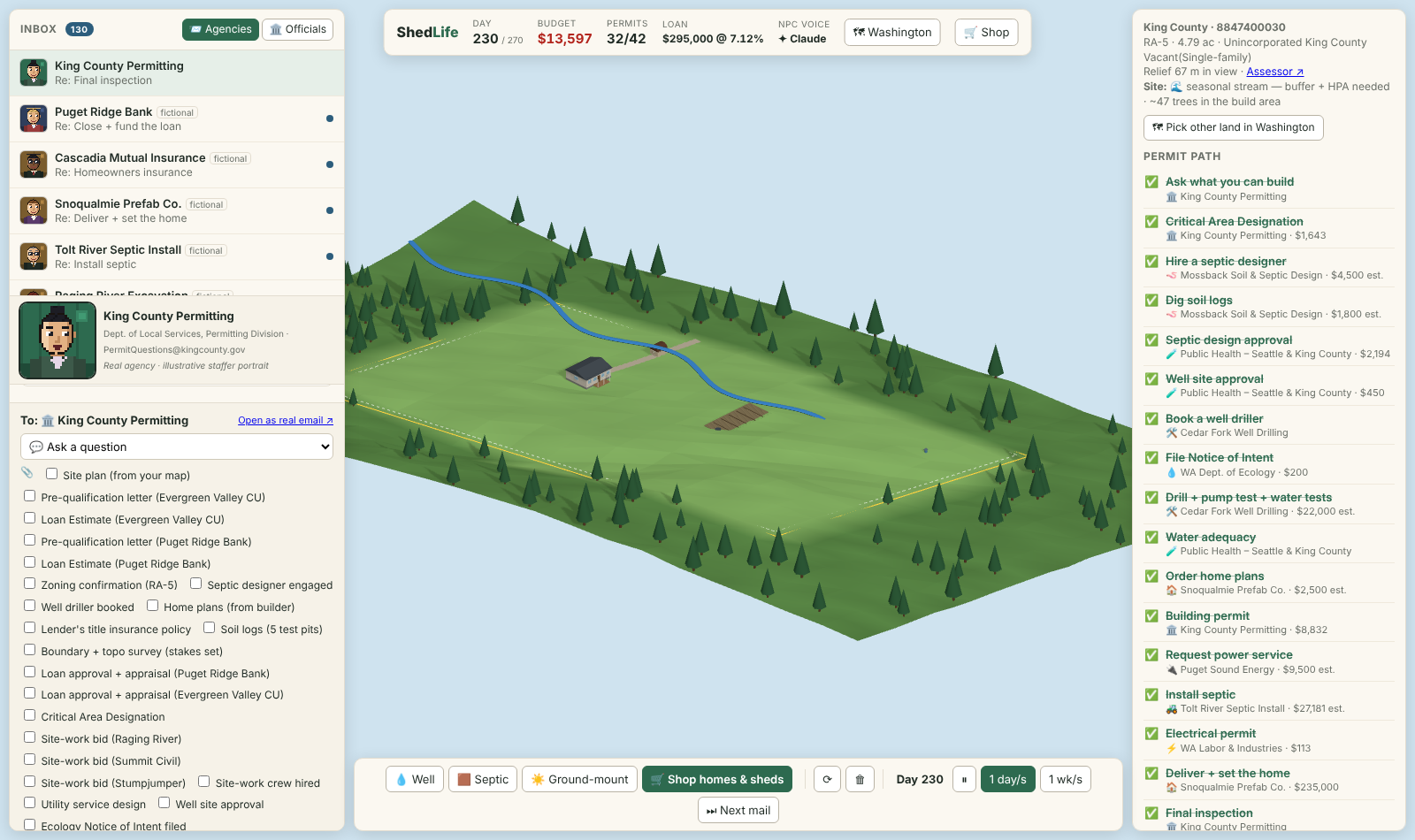
I built ShedLife for the Claude for Games hackathon in San Francisco on October 12, 2026. Earlier that day I'd rebuilt a 1992 DOS game in Three.js with AI as my pair, and a different idea showed up and wouldn't go away: what if the game was real? Not "realistic." Real. A real piece of land, the real permit path, real vendors, real fees, and a real bank. Same isometric view as SimCity, but every rule comes from the actual code.
The code is at github.com/rexsaurus/shedlife.
What I posted from the hackathon
ShedLife is built on a simple idea: What if buying and developing land with complete permit & regulatory automation was made into a fun game.
It pulls in real land data via @apify and models every plot, is based on the actual legal code and turns local administrators, banks into NPCs you can talk to.
Anyone can buy and develop their own tinyhome / shedland and simulate the process of minimum viable home ownership.
For the @claudeai game hackathon, I am building "ShedLife." It is a "near-sim." A simulation game that gets much closer to reality by sitting on top of actual government regulations.
Most simulation games are quite far from reality, with AI, we can model simulations much more closely on reality. But "slightly more fun."
The goal is to get to something closer to 70-80% to what it would be like in reality.
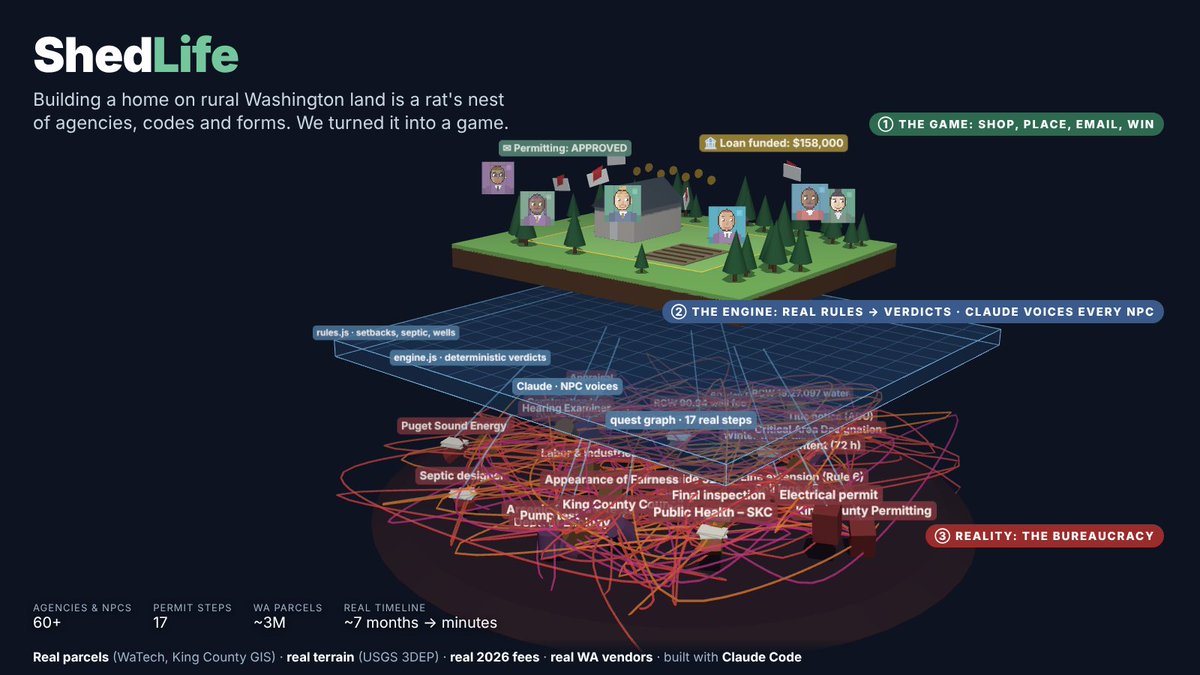
Why I'm building this
There are many plots of land in great locations, but converting them into somewhere livable involves a lot of permits, and those permits hamper the whole process. My idea is that if that could be automated, people could build for cheaper.
Every answer you need is public. Can I build here? What's the setback? Do I need a septic design before a well? Which office comes first? It's just spread across county GIS servers, code PDFs, fee schedules and permit portals. That maze stops a lot of people before they start. Games are really good at making systems like that legible. SimCity taught a lot of us how zoning, power and budgets interact. I want that same feeling, except the red line that blocks your drainfield is the real setback.
How it plays
You own a real vacant parcel in rural King County, Washington: 4.79 acres, zoned RA-5, real USGS terrain, with a stream running through it. To live there you need water, septic, power, a building permit and a final inspection. You start with cash, a budget and a deadline, and every move is an email.
- Draw a site plan on the isometric map: home, well, septic drainfield, and optionally sheds, an ADU, solar or an RV. Setbacks, the 100 foot well-to-drainfield rule, impervious limits and ADU and RV rules are checked live, each with its KCC or WAC citation.
- Email the right office. The Inbox lists agencies and NPCs, like King County Permitting, Public Health for septic, banks, insurers and prefab vendors. Pick a request, tick the documents you've earned, fill in the real-style application form, and send.
- Run the clock. Out of order gets "not yet." Missing papers get "needs info." Site plan problems get "corrections." Approvals issue reference numbers that later forms need and unlock the next step on the Permit Path, from soil logs and septic design to the well, building permit, power and final inspection, each with its real 2026 fee.
- Build it. Hire one of three site-work crews bidding on price, speed and rain risk, then fell trees, grade the pad and cut the driveway. Shop real Washington sheds, tiny homes, park models, modular homes and ADUs. (In King County a tiny home on wheels is legally an RV, which is a lesson in itself.)
- Pay for it. Pre-qualify with a bank, get an appraisal, compare Loan Estimates, close after the permit, and convert to a mortgage. Contractors invoice net 30, you can negotiate once, and unpaid bills turn into liens that block your loan.
- Win by passing final inspection before the deadline with every bill paid.
Around that loop there's a Foreman NPC who briefs you, a Summary screen, a Law view that quotes the actual RCW and WAC text (every citation in every email links to it), every seat on the major Seattle-area councils and commissions as animated 16-bit portraits of fictional people, day and night, wildlife, and time controls that fast-forward months of permit review.
Claude as the NPCs
The rule in ShedLife is that the engine decides and Claude narrates. A deterministic engine computes every verdict, fee and delay from the scenario's rules. Claude gets the NPC's persona, sourced knowledge about that agency, and the engine's facts, and writes the reply in character. It has to keep every fact and number. If there's no API key, the game falls back to scripted letters, so it always plays.
The repo is also built for Claude Code. It ships a CLAUDE.md guide and project skills for adding a county, an agency NPC, an official body, a vendor product or a quest, plus skills for verifying a regulation, refreshing data, voicing NPCs, playtesting and drafting a real email. There's a regulations-research subagent too.
Real data, the right way
- King County parcel and zoning GIS, plus statewide WaTech parcels so you can pick any vacant lot in Washington.
- USGS 3DEP elevation for the terrain.
- King County 2026 fee guides and the actual KCC, WAC and RCW rules, with citations on every rule and estimates labeled as estimates.
- Real Washington vendor products, with sizes, prices and sources.
- The earlier California prototype (San Mateo and Santa Clara GIS, RentCast land listings, county tax-sale lists) is still in the repo.
No scraping of commercial listing sites, no real people as characters (the officials sit on real bodies but are fictional), and real agencies are only reached through their public intake addresses.
Human in the loop
Any thread to a real agency can become a real email draft or portal link. You send it. The game never does. That's the long-term shape of ShedLife: AI does the legwork, the game shows you the consequences, and you approve every real-world action.
Games built on the legal code
The bigger idea behind ShedLife is that the rules of the realm come first, and the game gets built on top of them.
Simulation Games can get a lot more complex now. Imagine Skyrim, but you have 12,000 pages of the king's regulations to follow. Look at midieval laws for an idea of what used to get taxed and regulated.
Here are some examples: List of acts of the Parliament of England, 1422–1460
It might be quite fun to actually give the AI these regulations and tell it to generate the society around them as the basis of a game.

What's next
A harder county (Kittitas, with water-bank mitigation), random events like a failed perc test or a dry well, save and load, and real contractor license lookups.
If you build sheds, tiny homes or ADUs, work in permitting, or are a licensed contractor in Washington, I'd love to talk. I want ShedLife's rules to be the real ones.
Code: github.com/rexsaurus/shedlife. Project page: ShedLife.